

Author: Priscilla Wong

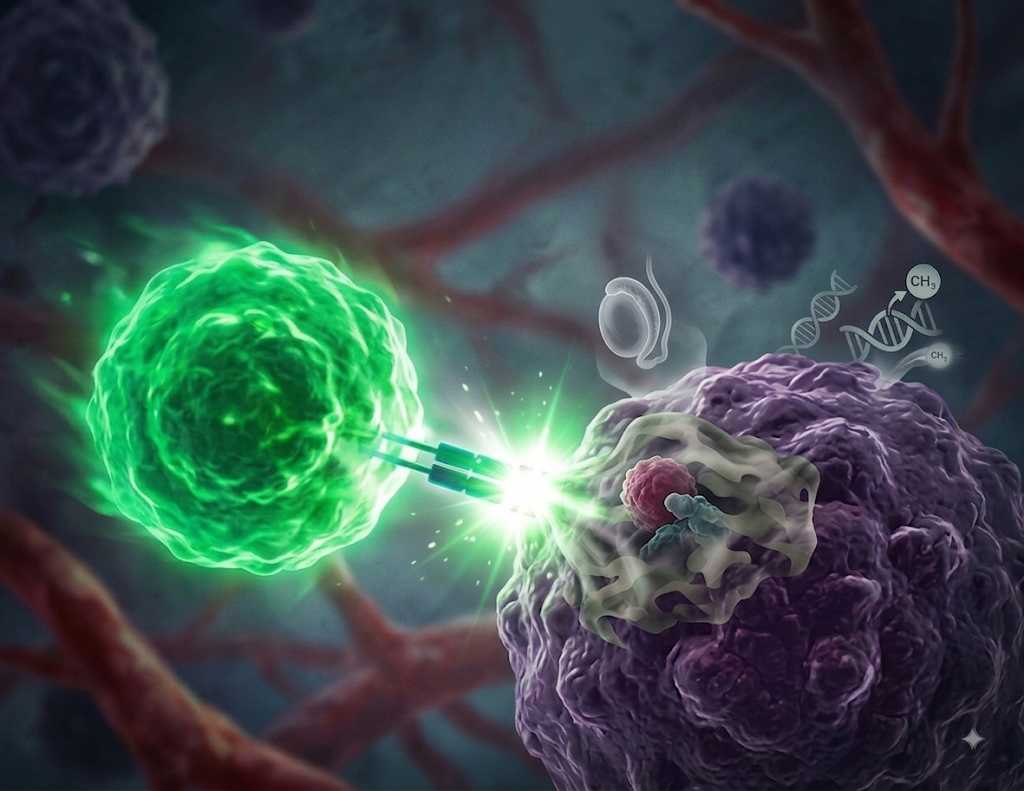
Image created by Priscilla Wong using Gemini
What if one of the best clues for identifying cancer cells came from proteins that are typically exclusive to the testes? This intriguing phenomenon is attributed to a group of unique proteins, termed cancer-testis antigens (CTA). CTAs were first discovered in 1991 and found to be almost completely absent in healthy adult cells, but upregulated in many types of cancer. As such, CTAs are attracting growing interest as promising targets for immunotherapy. But what exactly are CTAs and why do they appear in cancer cells?
CTAs are proteins normally produced in the testes, as well as the fetal ovaries and trophoblasts (the outer layer of cells of an early embryo)–a fact that was only recently discovered in the 2000s. Unlike most tissues in the body, the testes are an immune-privileged site, meaning immune cells have limited access to them. These reproductive cells also lack HLA class I molecules: molecular ‘ID tags’ that help immune cells recognise proteins, including CTAs, displayed by cells. As a result, the immune system rarely interacts with these proteins under normal circumstances.
However, cancer cells express CTAs, therefore displaying molecules that are not normally expressed on healthy body cells. To the immune system, these proteins appear foreign, potentially providing attractive immunotherapeutic targets.
But why do cancer cells express CTAs?
Cancer cells often accumulate various genetic and epigenetic (chemical modifications that influence gene activity without altering DNA sequences) changes compared to normal body cells. One of the most commonly observed changes is DNA hypomethylation. This is the loss of small chemical groups called methyl groups (CH3) from the DNA. DNA methylation is a primary way that cells use to turn on and off some genes; hypermethylation helps turn them off, and hypomethylation helps turn them on. Cancer cells often exhibit the loss of methyl groups, which can turn on genes, including CTAs, that may benefit tumour growth and survival.

Fig. 1. How CTAs differ in normal tissues versus cancer cells—and how T cells recognize them. (Image created by Priscilla Wong on BioRender)
In normal body cells, methylation helps keep CTA genes switched off. The absence or removal of these methyl groups switches on many CTAs in the testes and cancer cells. Notably, many CTAs have been identified in head and neck cancers and can actively promote tumour progression and survival. The many different CTAs have been linked to processes such as cancer-cell multiplication (e.g. MAGE-A3), formation of new blood vessels that feed tumours (e.g. DDX53), resistance to cell death (e.g. MAGE-A1), and the spread of cancer to other parts of the body (e.g. CT-GABRA3).
Given their involvement in tumour development and their distinct expression in cancer cells, CTAs offer a level of tumour specificity that makes them attractive targets for immunotherapy. Though CTAs are also expressed at high levels in the testes, they are immune-privileged, thereby limiting exposure to the immune system. This restricted expression, thus, makes CTAs attractive targets because therapies specific to them could distinguish cancer and healthy cells, directing the immune system to preferentially eliminate cancer cells while limiting damage to healthy tissues. As a result, this could potentially reduce the adverse, widespread side effects associated with conventional cancer treatments, especially chemotherapy.
Several CTAs, including PRAME, MAGE-A3 and NY-ESO-1, have been the focus of intensive research for this therapeutic purpose. These proteins are found in various cancers, including lung cancer, head and neck cancer, melanoma, and lymphoma. For instance, 79% of non-small cell lung cancer (NSCLC) cases have been shown to express at least one type of CTA, with MAGE-A4, PRAME, and MAGE-C2 being the most commonly observed CTAs.
Scientists are now developing novel therapies utilising these proteins to guide the immune system to recognise and eliminate cancer cells expressing them.
One strategy is T-cell receptor (TCR) engineered T cells. Modified immune cells, specifically T cells, are genetically engineered to carry specially designed receptors that recognise a particular CTA on cancer cells and exhibit stronger anti-tumour functions. For example, T cells engineered to recognise MAGE-A4 that also express another special receptor, CD8α, have shown stronger cytotoxicity (ability to kill abnormal/infected cells) against MAGE-A4+ tumour cells. These engineered T cells also release more of an immune-signalling molecule, interferon-gamma (IFN-γ), and exhibit enhanced activation of dendritic cells (immune cells that assist T cells). In fact, some trials (e.g. NCT02869217) have entered their clinical phase with this strategy!
Another strategy, currently clinically trialled against MAGE-A4 as well, involves using small drug molecules to specifically target and block the activity of a target CTA.
Researchers are also looking into whether CTA-targeted therapies can be combined with other immunotherapies. One such therapy is immune checkpoint inhibition, a treatment that removes the ‘brakes’ that normally prevent immune cells from attacking too strongly. This could potentially enhance the potency of the anti-tumour responses generated as opposed to just a single immunotherapy.
Despite the promising outlook CTAs offer, there are still several challenges.
Not every patient’s tumour expresses the same variety of CTAs even though it is the same cancer, and even within the same tumour, not all cancer cells express the same CTAs. This means that some cancer cells may be able to escape elimination, allowing continued tumour growth after treatment.
It is also possible that tumour cells can eventually develop resistance by not expressing CTAs, rendering treatment ineffective. Last but not least, tumour cells exhibit abnormal metabolism, which could hamper T-cell cytotoxicity against cancer cells.
Despite all these challenges, several CTA-targeted therapies have reached clinical trials. While they are still being refined, they remain a very promising cancer treatment. Researchers are also exploring personalised approaches to combat some of these challenges. Scientists could analyse several layers of biological information from an individual’s tumour, including its DNA, RNA and proteins, to identify the targets most suitable for treatment. This approach, known as multi-omics, is like creating a molecular fingerprint of each tumour, unique to each individual. This may be a possible way to minimise the challenges faced by CTA-targeted immunotherapies by finding the best treatment suited for each patient. Regardless, the unusual pattern of expression of CTAs offers an exciting opportunity to make cancer more visible to the immune system, representing a promising cancer immunotherapy, and potentially offering a more effective and safer option than conventional treatments.
Article written by Priscilla Wong, a recent BSc Biological Sciences (Immunology) (Hons) graduate from the University of Edinburgh and Head Online News Editor for EUSci.
Article edited by Emma Walsh, a final-year BSc Biomedical Sciences (Anatomy & Development) student from the University of Edinburgh and EUSci President (26/27).
References:
- Biology of Cancer-Testis Antigens and Their Therapeutic Implications in Cancer
- Cancer/testis (CT) antigens are expressed in fetal ovary – PMC
- Expression of cancer-testis (CT) antigens in placenta – PMC
- Autoimmunity and re-expression of cancer/testis antigens: Numerous disorders one mechanism hypothesis – ScienceDirect
- Oncogenic roles of DNA hypomethylation through the activation of cancer-germline genes
- Multiomic Selection of Cancer-Testis Antigens as Precision Immuno-oncologic Targets in Head and Neck Cancer | Reproductive Health | JAMA Otolaryngology–Head & Neck Surgery | JAMA Network
- Tumour Immunotherapy and Applications of Immunological Products: A Review of Literature – Oli – 2024
- Expression of cancer–testis antigens in the immune microenvironment of non‐small cell lung cancer – Hikmet – 2023 – Molecular Oncology – Wiley Online Library
- Cancer testis antigens: Emerging therapeutic targets leveraging genomic instability in cancer: Molecular Therapy Oncology
- Enhancing Efficacy of TCR-engineered CD4 + T Cells Via Coexpression of CD8α
Leave a Reply