

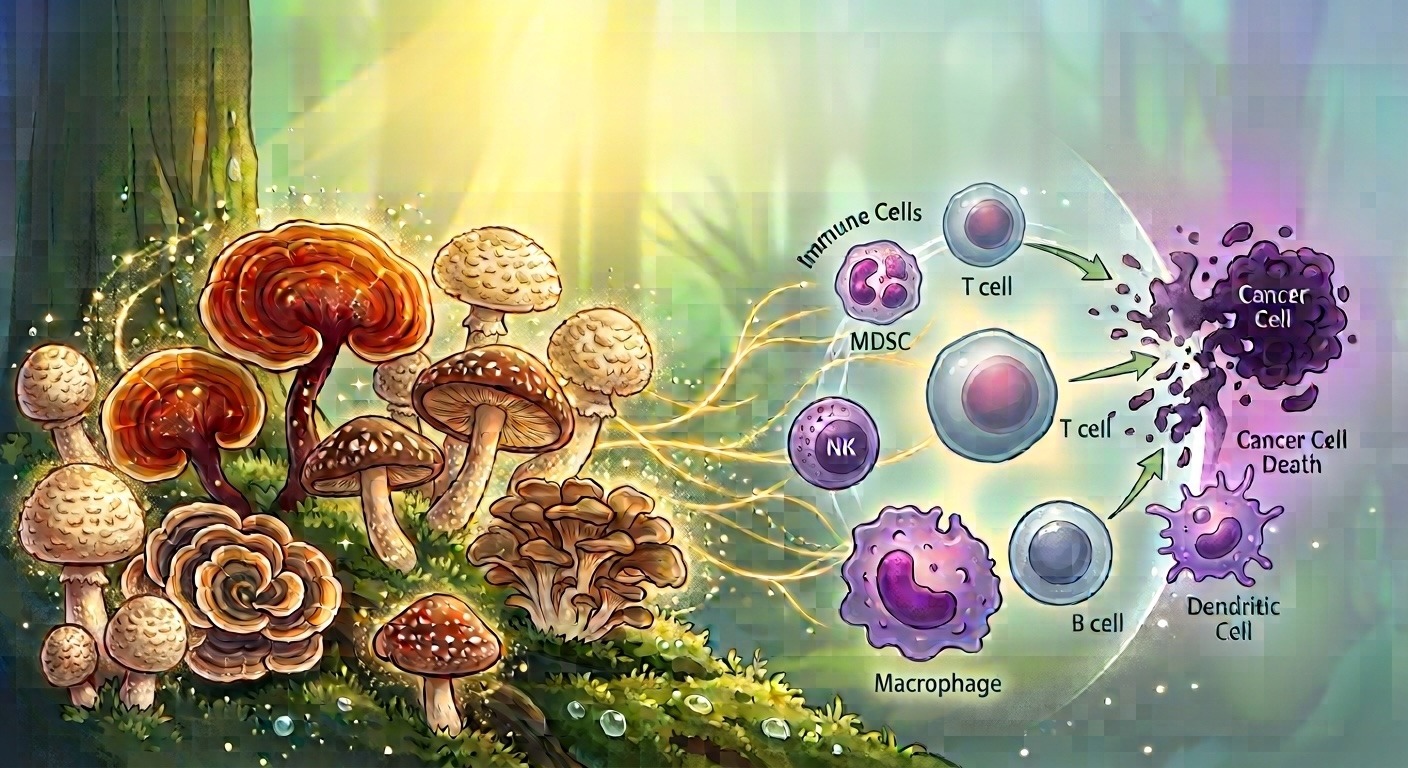
Author: Priscilla Wong

Image created by Priscilla Wong using Gemini
We often think of mushrooms as merely something to throw onto our dinner plate. But could these fungi do more than add flavour to our meals? Could they also help the immune system defend us against cancer?
For centuries, these fungi have been used in traditional medicine for their potential to regulate immunity, fight cancer and reduce inflammation. In fact, approximately 1 in 20 of the 14,000 known mushroom species are reported to have potential medicinal properties! As such, scientists have begun uncovering how the natural compounds in mushrooms could be harnessed as potential cancer therapies.
Unlike conventional cancer treatments, such as chemotherapy and radiotherapy, many studies have reported that mushroom-derived compounds have relatively favourable safety profiles. These effects have been attributed to various biologically active compounds. Furthermore, these compounds are reported to reduce unpleasant side effects (e.g. nausea, loss of appetite, anaemia) after chemotherapy and radiotherapy.
But how exactly do these mushroom-derived molecules interact with the immune system in cancer?
Mushroom-derived compounds can fight cancer in two main ways: by activating immune cells to attack and eliminate cancer cells, or by acting directly on cancer cells to trigger their deaths. These anti-tumour immune responses are activated via different regulatory pathways, depending on the type of mushroom-derived compound.
For instance, mushroom polysaccharides (complex carbohydrates consisting of many sugar molecules; e.g. β-glucans, lentinan) interact with pattern recognition receptors (PRRs), such as dectin-1 and toll-like receptors (TLRs). PRRs are specialised immune receptors that detect pathogen-associated molecular patterns (PAMPs), molecular features commonly found in microbes. Upon detection, various immune cells, including T cells, B cells, natural killer (NK) cells (rapid-response white blood cells against abnormal cells) and macrophages, are activated. Because tumours can suppress immune responses to escape elimination, mushroom polysaccharides may help lift this suppression and restore the immune system’s ability to attack them.
Another example of mushroom-derived compounds is terpenoids (natural chemical compounds produced by many living organisms), such as ganoderic acid T found in reishi, which can instead act directly on tumour cells. They have been shown to interfere with signalling pathways controlling cell growth and survival, such as PI3K/AKT/mTOR (regulates cell growth, multiplication, survival, and metabolism). Disrupting these pathways can trigger apoptosis (programmed cell death) (e.g. by activating caspases, proteins that trigger cell death) and autophagy (the breakdown and recycling of damaged/unwanted cellular components). They can also inhibit processes that tumours depend on, including proliferation (cell division), metastasis (spread of cancer to other body parts), and angiogenesis (blood vessel formation).
However, these effects are not identical across all mushrooms. Different species contain different bioactive compounds, with distinct effects on the immune system and tumour cells. So, how do some of the mushrooms that have attracted the most attention in cancer research actually fight cancer?

Fig. 1. Mushroom-derived bioactive compounds and their corresponding immune receptors. (Image created by Priscilla Wong using Gemini)
🍄🟫 Shiitake: Lentinan
Could a compound from an everyday mushroom help turn the immune system against cancer?
The shiitake mushroom (Lentinula edodes) has attracted considerable attention for its anti-cancer properties, triggering apoptosis in cancer cells and altering the tumour microenvironment by reducing inflammation and downregulating M2 macrophage formation. In fact, the anti-cancer activity of L. edodes has been tested in several clinical trials (e.g. NCT07118735)!
L. edodes produces lentinan, a type of β-glucan which consists of glucose units arranged in a distinctive branched structure. In a study in mice with sarcoma, a rare type of cancer that develops from connective tissues such as bones and muscles, lentinan showed approximately 75% inhibition of tumour growth with limited toxicity. Lentinan-treated mice showed a much higher accumulation of T cells and macrophages and greater anti-tumour immune responses in tumour tissues compared to untreated mice and mice treated with the chemotherapy drug Cytoxan. Furthermore, not only did lentinan increase tumour suppressor p53 expression to reduce tumour-cell proliferation, but it also promoted apoptosis through caspase-dependent pathways. Given the importance of blood vessel formation to supply nutrients and oxygen to tumours, the fact that lentinan is able to downregulate vascular endothelial growth factor (VEGF, a proangiogenic factor) is another piece of good news for cancer therapeutic researchers!
Besides acting on the immune system, lentinan has also been reported to act directly on tumour cells. In another study on lung adenocarcinoma (a type of non-small cell lung cancer), lentinan reduces cancer-cell proliferation, migration, invasion, and stemness (ability of cancer cells to behave like stem cells and continually produce new tumour cells), while increasing apoptosis. Researchers linked these effects to upregulated levels of miR-216a-5p, a small regulatory RNA, which in turn suppresses the JAK2/STAT3 signalling pathway involved in tumour growth and development.
Together, these studies suggest that lentinan demonstrates exceptional anti-tumour properties by enhancing anti-tumour immune responses and specifically targeting tumour cells through interfering with pro-tumour signalling pathways.
🍄🟫 Turkey tail: Polysaccharide Krestin (PSK) & Polysaccharide Peptide (PSP)
But what if a mushroom-derived compound could more specifically mobilise our immune system’s own cancer-fighting cells?
The turkey tail mushroom (Trametes versicolor) contains two special biologically active compounds, PSK and PSP. Both PSK and PSP are made up of small protein components attached to β-glucan chains, with similar sizes of around 100 kDa. Both compounds have been proven to influence immune-cell responses and cancer-cell behaviour.
One particularly interesting study in breast-tumour-bearing mice found that PSK binds to Toll-like receptor 2 (TLR2), a type of PRR, to stimulate anti-tumour immune responses involving tumour-specific CD8+ T cells (killer T cells) and NK cells. This could be attributed to PSK’s ability to promote the maturation of dendritic cells (DCs), immune cells that help activate other immune cells, including T and NK cells. PSK not only significantly increased the levels of tumour-specific T-cells, but also upregulated inflammatory cytokines (i.e. TNF-α, IFN-γ, CXCL1, IL-2) and enhanced NK-cell activity. This was supported by the observed decrease in levels of immunosuppressive regulatory T cells (Tregs). Overall, this PSK-induced immune response was shown to significantly reduce tumour growth.
But T. versicolor does not just rely on immune activation. In another study on human colorectal cancer (CRC) cells, PSP, which specifically binds to TLR4, reduced cancer-cell proliferation and promoted apoptosis. It also reduced the expression of both epidermal growth factor receptor (EGFR) and programmed cell death ligand 1 (PD-L1). Key molecules (i.e. c-Jun, STAT3, NF-κB) required for EGFR signalling were also downregulated. This is significant as EGFR promotes cancer-cell growth and survival, and can contribute to PD-L1 expression as well, while PD-L1 helps tumours evade immune destruction and triggers T-cell death. Hence, by reducing both, PSP may enhance the immune system’s ability to recognise and kill CRC cells, and simultaneously inhibit CRC cell proliferation.
What’s more fascinating is that these findings have also evolved beyond the laboratory. In a Phase I clinical trial in women with breast cancer (NCT00680667), researchers investigated the safety of orally administered T. vericolor after chemotherapy and radiotherapy. This treatment was able to mitigate the immunosuppressive effects of conventional cancer treatment by increasing the levels of CD8+ T cells and B cells, while enhancing NK-cell activity. Notably, no significant adverse side effects were observed. However, as a Phase I study, its primary purpose was to assess the safety and biological effects of turkey tail, rather than determine whether it could effectively treat breast cancer. The efficacy of turkey tail in treating breast cancer therefore remains undetermined. Encouragingly, the treatment has progressed to a Phase II clinical trial (NCT06450873), which has yet to be completed.
Regardless, turkey tail mushroom provides a promising example of how a mushroom-derived compound could not only reduce the side effects of conventional treatments but also enhance the immune system’s anti-cancer capabilities.
🍄🟫 Maitake: Maitake D (MD)-fraction
Activating immune cells is only half the battle: tumours can still actively suppress immune responses trying to destroy them. Could mushroom-derived compounds help remove these brakes?
Maitake (Grifola frondosa) contains another type of β-glucan, MD-fraction, which has been investigated for its ability to restore anti-tumour immune responses. Unlike most β-glucans, MD-fraction does not appear to enter the bloodstream to act on the immune system directly. In tumour-bearing mice, orally administered MD-fraction was captured by DCs and macrophages in special immune tissues located in the intestines, called Peyer’s Patches. MD-fraction is then transported to the spleen to induce systemic and tumour-specific immune responses. Specifically, MD-fraction activates DCs via Dectin-1, which in turn enhances their ability to activate T cells.
While levels of Tregs and myeloid-derived suppressor cells (MDSCs), which are major suppressors of anti-tumour immunity, were significantly reduced, activated CD4+ (helper T cells) and CD8+ T cells infiltrated tumours in greater numbers. The resulting response was skewed towards a Th1-type immune response, with CD4+ T cells producing more IFN-γ and less IL-4, and antigen-presenting cells (i.e. DCs, macrophages) producing more IL-12, which further promotes this response. Consistent with how Th1-type response is associated with stronger anti-tumour immunity, tumour growth was indeed significantly inhibited.
🍄🟫 Reishi: Ganoderma lucidum polysaccharides (GLPs) & ganoderic acid T (GA-T)
But what if some of the immune cells surrounding a tumour are actually helping the cancer hide?
Reishi (Ganoderma lucidum) contains many bioactive compounds, especially GLPs and triterpenoids, such as GA-T.
A key target of GLPs is MDSCs. In mice bearing lung tumours, GLP treatment reduced MDSC accumulation in spleen and tumour tissues, while upregulating CD4+ and CD8+ T cells, complemented by the production of Th1-cytokines IFN-γ and IL-12 in the spleen. This may be explained by GLP’s effects on the CARD9-NF-κB-IDO signalling pathway, which is associated with promoting the differentiation of MDSCs into mature immune cells, like DCs and macrophages. By reducing the accumulation of immunosuppressive MDSCs, GLP can therefore help restore the immune system’s ability to mount an anti-tumour response.
However, G. lucidum offers another unique possibility: killing tumour cells directly.
In human cancer cells, researchers discovered that GA-T is able to inhibit cancer-cell proliferation through cell cycle arrest (blocking the process of cell growth and multiplication) and induce apoptosis. Specifically, in human metastatic lung cancer cells, GA-T upregulated proteins p53 and Bax, which in turn disrupted the mitochondrial (powerhouse of the cell) membrane potential and triggered the release of cytochrome c from mitochondria into the cytoplasm (jelly-like fluid in the cell). Ultimately, this activated caspase-3, promoting apoptosis.
This gave G. lucidum a unique way of reducing tumour growth by relieving immunosuppression around the tumour and directly eliminating cancer cells, while exhibiting low toxicity against healthy cells.
🍄🟫 Almond mushroom: Acid-treated fraction (ATF)
What if a mushroom-derived preparation could make tumour cells vulnerable via two mechanisms simultaneously?
Similar to G. lucidum, the almond mushroom (Agaricus blazei Murrill, ABM) can directly kill cancer cells by disrupting the mitochondrial membrane in a sarcoma mouse model. This effect can be attributed to an ATF isolated from fruiting bodies (spore-producing structures) of the mushroom. Further purification showed that the tumour-killing activity was concentrated in fractions containing (1→4)-α-D-glucan and (1→6)-β-D-glucan, 2 types of polysaccharides found in ATF. ATF treatment was also proven to promote NK-cell tumour infiltration, including metastatic tumours, where they exhibited significant tumour-specific cytotoxicity. Importantly, these cytotoxic effects of ATF were not exhibited against healthy cells.

Fig. 2. Immunological mechanisms of mushroom-derived compounds against cancer cells. (Image created by Priscilla Wong on BioRender)

Fig. 3. Apoptotic mechanisms against cancer cells of mushroom-derived compounds. (Image created by Priscilla Wong on BioRender)
Across these 5 mushrooms, one thing becomes clear: Mushroom-derived compounds not only have different ways of fighting cancer, be it enhancing anti-tumour immunity or directly killing cancer cells, but also have relatively low toxicity against healthy cells in preclinical studies. So, if these mushroom-derived compounds have already shown significant benefits in patients, what still stands between these intriguing fungi and their wider development as approved cancer therapies?
One major challenge is that not all mushroom-derived compounds have reached the same stage. While many mushrooms have been approved as additions to standard cancer treatments or used alone in countries like Japan and China, there is still insufficient evidence to allow them to become official cancer treatments worldwide. The few clinical trials in humans on a small number of mushrooms have also reported improved survival and enhanced anti-tumour immune responses, especially when mushroom-derived compounds were combined with conventional treatments. However, most evidence on other mushroom-derived compounds still comes from experiments in human cells and animals.
Another challenge is that mushrooms are not always chemically identical. Their bioactive properties may vary depending on the strain (a subgroup within a species), where and how they were grown, the part of the mushroom used, harvesting time, and compound extraction process. As a result, findings on a single mushroom compound may differ across studies.
Overall, developing standardised methods for growing, harvesting, and extracting mushroom compounds, alongside conducting experiments on more cancer types and performing larger clinical trials, will be needed to produce reliable and reproducible treatments. Regardless, their selective toxicity towards cancer cells and ability to enhance the immune system’s anti-tumour immunity make mushroom-derived compounds intriguing candidates for developing safer and potentially more effective cancer therapies.
Article written by Priscilla Wong, a recent BSc Biological Sciences (Immunology) (Hons) graduate from the University of Edinburgh and the Head Online News Editor for EUSci.
Article edited by Niki Chan, a final-year BSc (Hons) Biomedical Sciences student from the University of Edinburgh, and EUSci Co-Editor in Chief (26/27).
References:
- Ajit, J. and Ambrožič, R. (2025). Medicinal mushroom-derived compounds for managing neuro-gastrointestinal and physical symptoms in cancer patients: Mechanisms, clinical evidence, and future directions. Clinical Immunology Communications, [online] 8, pp.109–119. doi:10.1016/j.clicom.2025.11.001.
- Akira, S., Uematsu, S. and Takeuchi, O. (2006). Pathogen recognition and innate immunity. Cell, [online] 124(4), pp.783–801. doi:10.1016/j.cell.2006.02.015.
- American Botanical Council (2014). Lentinus edodes: Clinical Trials. [online] Herbalgram.org. Available at: https://www.herbalgram.org/resources/herbmedpro/herb-list/lentinus-edodes?subCat=Clinical%20Trials.
- Camilleri, E., Blundell, R., Karpiński, T.M., Panda, J., Nath, P.C., Mohanta, Y.K., Aruci, E. and Atrooz, O.M. (2025). The therapeutic potential of Shiitake Mushrooms (Lentinula edodes). Next Research, [online] 2(3), p.100632. doi:10.1016/j.nexres.2025.100632.
- Chen, Q., Zheng, Y., Chen, X., Ge, P., Wang, P. and Wu, B. (2021). Upregulation of miR-216a-5p by Lentinan targeted inhibition of jak2/STAT3 signaling pathway to reduce lung adenocarcinoma cell stemness, promote apoptosis, and slow down the lung adenocarcinoma mechanisms. Frontiers in Oncology, [online] 11. doi:10.3389/fonc.2021.778096.
- Fujimiya, Y., Suzuki, Y., Oshiman, K., Kobori, H., Moriguchi, K., Nakashima, H., Matumoto, Y., Takahara, S., Ebina, T. and Katakura, R. (1998). Selective tumoricidal effect of soluble proteoglucan extracted from the basidiomycete, Agaricus blazei Murill, mediated via natural killer cell activation and apoptosis. Cancer Immunology, Immunotherapy, [online] 46(3), pp.147–159. doi:10.1007/s002620050473.
- Glaviano, A., Song, A., Julia, Y., Yap, K.C.-Y., Jacot, W., Jones, R.H., Eng, H., Nair, M.G., Makvandi, P., Geoerger, B., Kulke, M.H., Baird, R. D, Prabhu, J.S., Carbone, D., Pecoraro, C., Boon, D., Sethi, G., Cavalieri, V., Lin, K., Javidi-Sharifi, N., Toska, E., Davids, M.S., Brown, J.R., Diana, P., Stebbing, J., Fruman, D.A. and Kumar, A.P. (2023). PI3K/AKT/mTOR signaling transduction pathway and targeted therapies in cancer. Molecular Cancer, [online] 22(1). doi:10.1186/s12943-023-01827-6.
- Jian, L., Zhicheng, H. and shubai, L. (2022). Polysaccharide peptide induced colorectal cancer cells apoptosis by down-regulating EGFR and PD-L1 expression. Iranian Journal of Pharmaceutical Research, [online] 21(1). doi:10.5812/ijpr-123909.
- Kodama, N., Harada, N. and Nanba, H. (2002). A polysaccharide, extract from grifola frondosa, induces Th-1 dominant responses in carcinoma-bearing BALB/C MICE. Japanese Journal of Pharmacology, [online] 90(4), pp.357–360. doi:10.1254/jjp.90.357.
- Kuttan, G., Pratheeshkumar, P., Manu, K.A. and Kuttan, R. (2011). Inhibition of tumor progression by naturally occurring terpenoids. Pharmaceutical Biology, [online] 49(10), pp.995–1007. doi:10.3109/13880209.2011.559476.
- Lu, H., Yang, Y., Gad, E., Wenner, C.A., Chang, A., Larson, E.R., Dang, Y., Martzen, M., Standish, L.J. and Disis, M.L. (2011). Polysaccharide krestin is a novel TLR2 agonist that mediates inhibition of tumor growth via stimulation of CD8 T cells and NK cells. Clinical Cancer Research, [online] 17(1), pp.67–76. doi:10.1158/1078-0432.ccr-10-1763.
- Masuda, Y., Inoue, H., Ohta, H., Miyake, A., Konishi, M. and Nanba, H. (2013). Oral administration of soluble β‐glucans extracted from Grifola frondosa induces systemic antitumor immune response and decreases immunosuppression in tumor‐bearing mice. International Journal of Cancer, [online] 133(1), pp.108–119. doi:10.1002/ijc.27999.
- Mudgil, D. (2017). The interaction between insoluble and soluble fiber. Dietary Fiber for the Prevention of Cardiovascular Disease, [online] pp.35–59. doi:10.1016/b978-0-12-805130-6.00003-3.
- Park, H.-J. (2022). Current uses of mushrooms in cancer treatment and their anticancer mechanisms. International Journal of Molecular Sciences, [online] 23(18), p.10502. doi:10.3390/ijms231810502.
- PDQ Integrative, Alternative, and Complementary Therapies Editorial Board (2024). Medicinal mushrooms (PDQ®): Patient version. [online] PubMed. Available at: https://www.ncbi.nlm.nih.gov/books/NBK424937/.
- Tang, W., Liu, J.-W., Zhao, W.-M., Wei, D.-Z. and Zhong, J.-J. (2006). Ganoderic acid T from Ganoderma lucidum mycelia induces mitochondria mediated apoptosis in lung cancer cells. Life Sciences, [online] 80(3), pp.205–211. doi:10.1016/j.lfs.2006.09.001.
- Tesi, R.J. (2018). MDSC; the most important cell you have never heard of. Trends in Pharmacological Sciences, [online] 40(1), pp.4–7. doi:10.1016/j.tips.2018.10.008.
- Torkelson, C.J., Sweet, E., Martzen, M.R., Sasagawa, M., Wenner, C.A., Gay, J., Putiri, A. and Standish, L.J. (2012). Phase 1 clinical trial of trametes versicolor in women with breast cancer. ISRN oncology, [online] p.251632. doi:10.5402/2012/251632.
- Valverde, M.E., Hernández-Pérez, T. and Paredes-López, O. (2015). Edible mushrooms: Improving human health and promoting quality life. International Journal of Microbiology, [online] 2015(376387), pp.1–14. doi:10.1155/2015/376387.
- Wang, Y., Fan, X. and Wu, X. (2020). ganoderma lucidum polysaccharide (GLP) enhances antitumor immune response by regulating differentiation and inhibition of MDSCs via a CARD9-NF-κB-IDO pathway. Bioscience Reports, [online] 40(6). doi:10.1042/bsr20201170.
- Xu, H., Zou, S., Xu, X. and Zhang, L. (2016). Anti-tumor effect of β-glucan from Lentinus edodes and the underlying mechanism. Scientific Reports, [online] 6(1). doi:10.1038/srep28802.
- Zade, S., Upadhyay, T.K., Rab, S.O., Sharangi, A.B., Lakhanpal, S., Alabdallah, N.M. and Saeed, M. (2025). Mushroom-derived bioactive compounds pharmacological properties and cancer targeting: A holistic assessment. Discover Oncology, [online] 16(1). doi:10.1007/s12672-025-02371-z.
Leave a Reply