

Author: Shammi Thakur

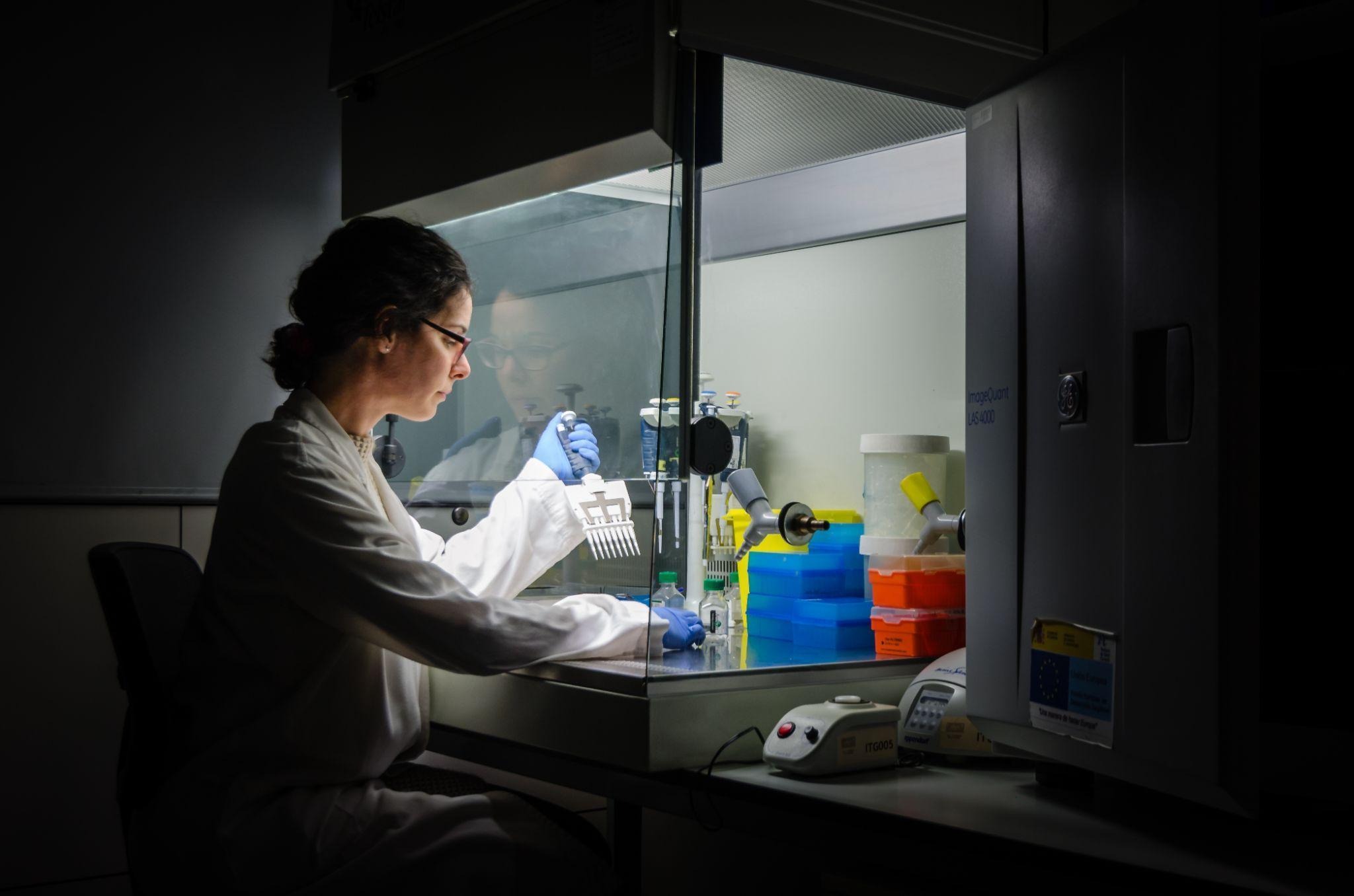
Image credit: “Researcher at work in her laboratory” by Alessandro Ventura, photographed at the Vall d’Hebron Institute of Research (VHIR), Barcelona, on 4 January 2016. Source: Wikimedia Commons. Licensed under Creative Commons Attribution 4.0 International (CC BY 4.0).

What changes when artificial intelligence (AI) does more than analyse scientific information and starts suggesting what researchers should test next? In one study, an AI system proposed potential drug candidates for acute myeloid leukaemia (AML), an aggressive blood cancer. In another, researchers used AI to identify compounds that could be tested for their potential to treat dry age-related macular degeneration, a condition that can damage central vision.
Both studies were published in Nature in May 2026. The multi-agent AI system Co-Scientist generates and refines hypotheses, while Robin links hypothesis generation with experimental data analysis to suggest further investigations [1,2].
Generating and Testing Scientific Hypotheses
A scientific hypothesis is an explanation that can be tested against evidence. Developing one often requires researchers to connect findings spread across scientific papers and specialised databases [1]. AI systems such as Co-Scientist are designed to help with this process.
As a multi-agent AI system, Co-Scientist is made up of several specialised agents based on Google’s Gemini model. These agents generate ideas, critique proposals, compare alternatives, and refine hypotheses, while a supervisory agent coordinates their work. The system draws on scientific literature and can use web searches and specialist databases, such as ChEMBL and UniProt, as well as tools such as AlphaFold [1,3]. Researchers set the research objectives and decide which proposals warrant experimental testing.
The researchers evaluated Co-Scientist on several biomedical problems, including drug repurposing, which explores new uses for existing medicines. In one application, the system proposed existing medicines and other compounds for investigation as potential treatments for AML. Researchers tested selected candidates in four AML cell lines representing different disease subtypes and also included a separate non-cancerous cell line as a control, which helps researchers assess whether an observed effect is specific to the cancer cells being studied. Cell lines are populations of cells maintained in laboratory cultures so researchers can study disease-related behaviour under controlled conditions. Responses varied across the cell lines. A proposed compound, KIRA6, was found to be most active against KG-1a cells, while MOLM-13 and HL-60 cells were less sensitive to it. The different responses suggest that KIRA6 may be more effective against some AML cell types than others. Further research could help establish why these differences occur and whether the findings have relevance for future AML treatment development [1].
These experiments provided an initial assessment of the proposed candidates’ biological activity, helping researchers decide which might warrant extensive validation before committing time and laboratory resources. However, results from cell lines alone cannot replace the preclinical and clinical assessments required to establish whether a treatment is safe and effective in people [1].
A Related Application: Liver Fibrosis Research
A similar approach was explored in an earlier, separate study published in Advanced Science in 2025. Researchers used Co-Scientist to identify potential drug-repurposing candidates for liver fibrosis, a condition in which scar tissue builds up after chronic liver injury [4].
The researchers assessed 25 drugs in human liver organoids containing several cell types, grown in microwells. Organoids are three-dimensional (3D) laboratory-grown cell models that reproduce selected features of human tissue, while microwells are small compartments used to grow and hold these samples. The study found that two of three AI-recommended drugs targeting epigenomic modifiers showed significant anti-fibrotic activity. Epigenomic modifiers influence how genes are regulated without changing the underlying DNA sequence [4].
Although these results suggest that the candidates warrant further investigation, organoids reproduce only selected features of an organ. These results, therefore, require further studies to establish whether these drug candidates could eventually be developed into treatments for patients [4].
Using Experimental Results to Guide Further Research
While Co-Scientist concentrates on generating and refining hypotheses, Robin takes a more iterative approach by connecting literature searches with the analysis of experimental data. Robin can propose a hypothesis, suggest an experiment, interpret the resulting data, and use those findings to generate a new research question [2].
Researchers used Robin to investigate dry age-related macular degeneration, which affects the macula, the central part of the retina at the back of the eye. The system proposed increasing phagocytosis by retinal pigment epithelial cells as a possible therapeutic strategy. These cells help support the retina, while phagocytosis is the process through which cells take up and break down materials such as cellular debris [2].
The researchers conducted initial experiments and then used Robin to identify possible next steps. The system recommended RNA sequencing of cells treated with Y-27632, a compound that inhibits ROCK enzymes, which help regulate the cell’s internal structure, signalling, and other cellular processes involved in phagocytosis. RNA (ribonucleic acid) is a molecule that helps cells use the genetic instructions stored in DNA. RNA sequencing measures RNA molecules in a sample to reveal which genes are active and to what extent, thereby allowing the researchers to investigate the effects of inhibiting ROCK enzymes. The analysis revealed an increased expression of ABCA1, a gene that encodes a protein involved in moving fats out of cells [2]. This gave researchers another clue to investigate, rather than proving how the treatment worked.
Robin subsequently identified two further drug candidates, ripasudil and KL001. Researchers later used further RNA sequencing and found that increased ABCA1 also occurred in cells treated with ripasudil, while other laboratory experiments found that both drugs effectively increased phagocytic activity in the retinal cells tested [2].
These findings provide experimental support for further investigation, but they do not demonstrate that either compound can treat macular degeneration in patients. As such, testing in living organisms would be needed to assess their effects more fully [2].
Predicting Protein Structures with AI
AI can also help researchers predict protein structures, rather than simply suggesting which compounds to test. One prominent example is AlphaFold, an AI model that predicts the 3D structures of proteins from their amino acid sequence.
A protein’s 3D shape influences how it interacts with other molecules and performs its biological functions [5]. In 2021, researchers reported that AlphaFold achieved high accuracy in a major protein-structure prediction assessment [6]. Such predictions can help researchers identify regions for further study and design experiments to investigate specific structural hypotheses [7].
Scientists also use experimental methods to determine protein structures. These include X-ray crystallography, which analyses the patterns formed when X-rays scatter from a crystallised protein to determine its structure; nuclear magnetic resonance (NMR) spectroscopy, which uses strong magnets and radio waves to study the structure of molecules; and cryo-electron microscopy, which images frozen samples to reconstruct high-resolution, 3D structures of proteins and other biological molecules [8].
Despite its capabilities, AlphaFold’s predicted structures do not capture every feature of a protein in its biological environment. Prediction accuracy varies, and predictions may not account for bound molecules, chemical modifications, or other environmental factors. Researchers may therefore need additional evidence to understand how a protein behaves in a cell. AlphaFold predictions provide useful starting points for research, but they do not replace experimental structure determination, which is necessary to validate predicted protein structures and investigate how proteins interact with other molecules [6,7].
Automating Parts of Computational Research
Beyond predicting biological structures or suggesting experiments, AI can also help automate computational research. In this type of research, scientists use computer code, simulations, and data analysis to test ideas without necessarily carrying out physical laboratory procedures.
A 2026 Nature study introduced The AI Scientist, a system designed to automate several stages of machine-learning research. It can generate research ideas, write code, run computational experiments, analyse results, prepare manuscripts, and conduct automated peer review [9].
The researchers evaluated the system in two modes: one that started with human-provided code templates and another that generated its own starting code. They found that performance improved with more computing resources and stronger underlying models [9].
The study also examined whether AI-generated research papers could pass through a scientific peer-review process. Three AI-generated manuscripts were submitted to a machine-learning conference workshop associated with the International Conference on Learning Representations. One scored above the workshop’s acceptance threshold, but the researchers had agreed in advance to withdraw all AI-generated submissions after peer review, regardless of their scores. The other two did not meet the threshold. The researchers also reported limitations, including underdeveloped ideas, coding errors, weak methods, and inaccurate citations [9].
These results illustrate both the potential and the limitations of automating research. AI may be able to automate many steps in a computational research workflow, but producing a manuscript does not, by itself, establish that the research is reliable or scientifically valuable.
Developing AI for Specialised Scientific Research
AI tools are also being developed for specific scientific fields. Particle physics, for example, studies the fundamental particles that make up matter and how they interact [10].
On 15 October 2026, CERN and Mistral announced a partnership to develop foundation models for scientific research. According to Reuters, the planned model for particle-collider research, Flare, is intended to be trained on billions of simulated particle collisions. It could eventually help replace some specialised algorithms used to reconstruct collision events and identify particles [11,12]. The distinction between a proposed application and a demonstrated result is important here. The announcement describes a development project, not a completed model whose intended performance has already been demonstrated [11,12].
Verifying AI-Assisted Scientific Research
Across these examples, AI can propose hypotheses, predict a protein’s biological structure, or help analyse experimental data. However, none of these AI-generated suggestions automatically constitute a scientific conclusion. Each must still be assessed against appropriate evidence and methods.
AI systems used in research can produce inaccurate outputs when the data used to develop or evaluate them do not adequately represent the people, samples or conditions to which they are later applied. For example, a system trained on non-representative data (a dataset that does not accurately reflect the real-world population) may be less reliable when applied to certain demographic groups [13].
Some AI systems used in scientific research utilise large language models, a type of generative AI, which can generate content based on user inputs. For example, Co-Scientist uses Gemini-based agents to generate and refine research hypotheses, while The AI Scientist uses language models to develop research ideas, write code and prepare scientific manuscripts [1,9]. However, generative AI can also produce convincing but inaccurate or fabricated information [13]. A study examining citations generated by ChatGPT found both fabricated references and errors in existing ones. Researchers therefore need to verify AI-generated claims and references against the original scientific literature [14].
Researchers must also distinguish association from causation. Two measurements may be related without one directly causing the other; both could instead be influenced by a third factor. As such, appropriate study designs are needed to test alternative explanations [15].
Scientific findings must also be open to independent checking. This includes both reproducibility and replicability. Reproducibility involves obtaining consistent results using the same data and methods. Replicability (independent testing using newly collected data) examines whether a separate study addressing the same question produces similar findings [16].
Achieving these standards and obtaining reliable scientific findings depend on detailed reporting. Computational researchers should record the data, code, software packages, versions and settings needed to repeat an analysis. Laboratory researchers should report details such as cell-line identity, controls, sample sizes, reagents and experimental procedures. This information helps other researchers understand how a study was conducted, as differences in samples, laboratory conditions or contamination may explain variations in results. As such, rigorous reporting and appropriate replication are important to assess potential variations [17,18].
Researchers should also report unsuccessful experiments and findings that do not support the main hypothesis, as negative results can help scientists reject unsupported explanations and avoid unnecessarily repeating unsuccessful research. Transparent reporting also includes acknowledging sources of uncertainty. These may include differences in reagents (the chemicals or biological materials used in experiments) or laboratory conditions, insufficient statistical power (when a study has too few observations to reliably detect an effect), or the complexity of the biological system being studied [19]. NIH guidelines emphasise transparent reporting of experimental methods, results and statistical information, including findings that do not support the main hypothesis [18].
Reporting such findings is important in its own right. Negative results can help researchers rule out explanations that lack supporting evidence, avoid unnecessarily repeating unsuccessful work, and instead direct time and resources towards other potentially productive research questions [19].
Why Human Oversight Remains Essential
These limitations highlight why researchers must remain involved throughout the scientific process. They are responsible for deciding which questions are worth investigating, selecting appropriate methods and determining whether evidence supports a conclusion. They must also check AI-generated content, acknowledge relevant use of AI and protect sensitive research data. The International Committee of Medical Journal Editors states that human authors remain accountable for work submitted for publication, while guidance from the United Nations Educational, Scientific and Cultural Organization (UNESCO) and the All European Academies (ALLEA) also emphasises human oversight, transparency and research integrity [20–22].
Building the Next Stage of Scientific Discovery
AI is beginning to connect literature review, hypothesis generation, data analysis and experimentation. These tools can help researchers examine large bodies of information and explore questions that might otherwise take considerable time to formulate. But their value will depend on how well their predictions and suggestions stand up to testing, and on the care with which researchers test and interpret the evidence.
Article written by Shammi Thakur is Research Director at Markntel Advisor, with more than 15 years of experience in research, strategic intelligence, industry analysis, forecasting and competitive insights. His work examines technology adoption, business trends, and the operational factors that influence organisational decisions.
Article edited by Priscilla Wong, a recent BSc Biological Sciences (Immunology) (Hons) graduate from the University of Edinburgh and the Head Online News Editor for EUSci.
References:
[1] Gottweis J, Weng WH, Daryin A, et al. Accelerating scientific discovery with Co-Scientist. Nature. 2026;655:487–496. https://doi.org/10.1038/s41586-026-10644-y
[2] Ghareeb AE, Chang B, Mitchener L, et al. A multi-agent system for automating scientific discovery. Nature. 2026;655:497–505. https://doi.org/10.1038/s41586-026-10652-y
[3] Google DeepMind. Co-Scientist: A multi-agent AI partner to accelerate research. 19 May 2026. https://deepmind.google/blog/co-scientist-a-multi-agent-ai-partner-to-accelerate-research/
[4] Guan Y, Cui L, Inchai J, et al. AI-Assisted Drug Re-Purposing for Human Liver Fibrosis. Advanced Science. 2025;12(44). https://doi.org/10.1002/advs.202508751
[5] Alberts B, Johnson A, Lewis J, et al. Molecular Biology of the Cell. 4th edition. New York: Garland Science; 2002. Chapter 3: The Shape and Structure of Proteins. https://www.ncbi.nlm.nih.gov/books/NBK26830
[6] Jumper J, Evans R, Pritzel A, et al. Highly accurate protein structure prediction with AlphaFold. Nature. 2021;596:583–589. https://doi.org/10.1038/s41586-021-03819-2
[7] Terwilliger TC, Liebschner D, Croll TI, et al. AlphaFold predictions are valuable hypotheses and accelerate, but do not replace experimental structure determination. Nature Methods. 2024;21:110–116. https://doi.org/10.1038/s41592-023-02087-4
[8] RCSB Protein Data Bank. Methods for Determining Structure. https://pdb101.rcsb.org/learn/guide-to-understanding-pdb-data/methods-for-determining-structure
[9] Lu C, Lu C, Lange RT, et al. Towards end-to-end automation of AI research. Nature. 2026;651:914–919. https://doi.org/10.1038/s41586-026-10265-5
[10] CERN. Physics. https://home.cern/science/physics/
[11] CERN. CERN and Mistral join forces to accelerate AI for science. 15 October 2026. https://home.cern/cern-and-mistral-join-forces-to-accelerate-ai-for-science/
[12] Marchandon L. CERN and Mistral partner to build Flare, a new AI model for physics. Reuters. 15 October 2026. https://www.reuters.com/science/cern-mistral-partner-build-ai-foundation-models-physics-2026-10-15/
[13] Autio C, Schwartz R, Dunietz J, et al. Artificial Intelligence Risk Management Framework: Generative Artificial Intelligence Profile. NIST AI 600-1. National Institute of Standards and Technology; 2024. https://doi.org/10.6028/NIST.AI.600-1
[14] Walters WH, Wilder EI. Fabrication and errors in the bibliographic citations generated by ChatGPT. Scientific Reports. 2023;13:14045. https://doi.org/10.1038/s41598-023-41032-5
[15] Hernán MA, Robins JM. Causal Inference: What If. Boca Raton: Chapman & Hall/CRC; 2020. https://miguelhernan.org/whatifbook
[16] National Academies of Sciences, Engineering, and Medicine. Reproducibility and Replicability in Science. Washington, DC: National Academies Press; 2019. https://doi.org/10.17226/25303
[17] Loscalzo J. Experimental Irreproducibility: Causes, (Mis)interpretations, and Consequences. Circulation. 2012;125(10):1211–1214. https://doi.org/10.1161/CIRCULATIONAHA.112.098244
[18] National Institutes of Health. Principles and Guidelines for Reporting Preclinical Research. https://grants.nih.gov/policy-and-compliance/policy-topics/reproducibility/principles-guidelines-reporting-preclinical-research
[19] Nimpf S, Keays DA. Why (and how) we should publish negative data. EMBO Reports. 2020;21(1):e49775.
https://doi.org/10.15252/embr.201949775
[20] International Committee of Medical Journal Editors (ICMJE). Recommendations: Use of AI by Authors. https://www.icmje.org/recommendations/browse/artificial-intelligence/ai-use-by-authors.html
[21] United Nations Educational, Scientific and Cultural Organization (UNESCO). Recommendation on the Ethics of Artificial Intelligence. 2021. https://www.unesco.org/en/legal-affairs/recommendation-ethics-artificial-intelligence
[22] All European Academies (ALLEA). The European Code of Conduct for Research Integrity. Revised edition, 2023. https://allea.org/wp-content/uploads/2023/06/European-Code-of-Conduct-Revised-Edition-2023.pdf
Leave a Reply