

Author: Priscilla Wong

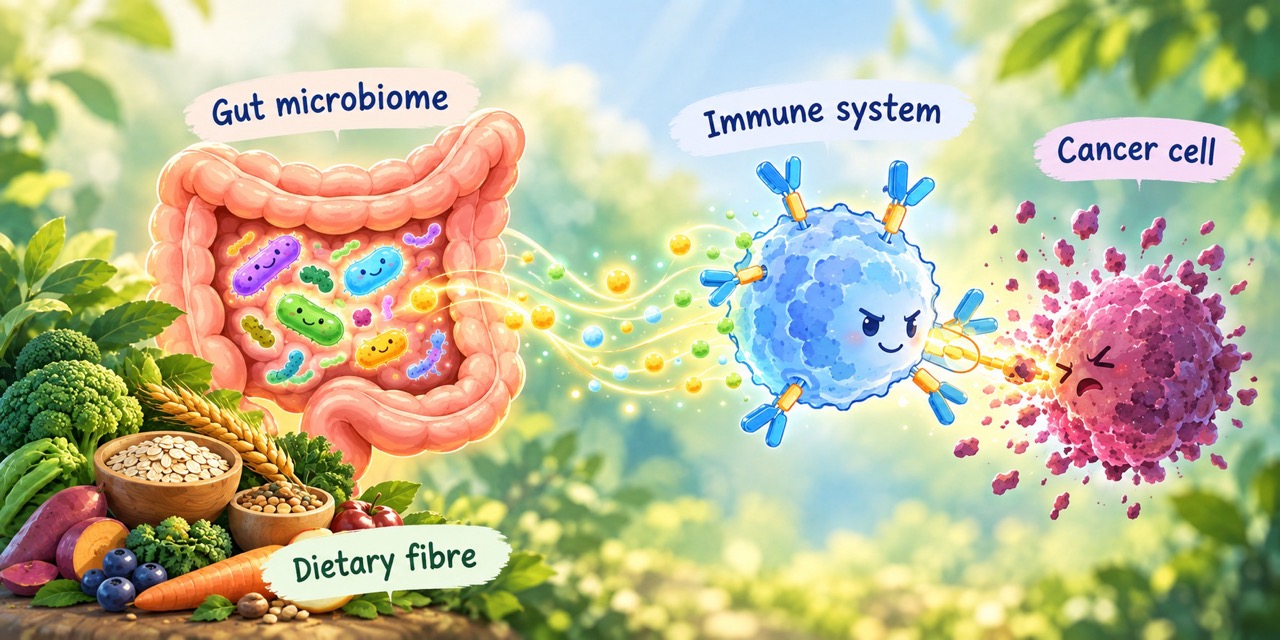
Image created by Priscilla Wong using ChatGPT
We often just think of our gut as the organ responsible for digesting the food we eat. But do you know that it is the home to 95% of our body’s resident microbes? What’s more interesting is that the gut microbiome has been shown to interact intimately with the immune system. Could this crosstalk affect how cancer-fighting immune cells work?
The gut microbiota refers to the trillions of microorganisms living in the gut (~38 trillion), which is approximately equivalent to the number of cells in a human adult (~30 trillion)! Besides helping digest food and extract nutrients that the body cannot metabolise on its own, these microbes can ferment dietary fibre (undigested carbohydrates). The resulting molecules are short-chain fatty acids (SCFAs), including butyrate, acetate and propionate.
These molecules can enter the bloodstream from the gut and influence immune cell activity by altering how immune cells produce energy and controlling which immune-related genes are switched on or off. This could ultimately enhance anti-cancer immunity and the efficacy of immunotherapy in cancer patients.
This intimate connection has been investigated in chimeric antigen receptor T-cell (CAR-T) therapy. This is a novel cancer treatment where the patient’s own T cells are collected, genetically modified to express CARs to recognise cancer cells via cancer-specific proteins, and reintroduced into the patient. CAR-T therapy has become a promising treatment for cancer patients, showing significant effectiveness in some blood cancers, including leukaemia (cancer of the bone marrow, the ‘blood cell factory’), lymphoma (cancer of the lymphatic system, the immune system network) and myeloma (cancer of plasma cells, the ‘antibody factory’).
However, not every patient responds to CAR-T therapy, while some patients’ cancer returns within the first few months after undergoing treatment. Moreover, CAR-T therapy can cause serious side effects. One of these side effects is cytokine release syndrome (CRS), an inflammatory reaction in which high levels of cytokines (small proteins released by cells to communicate with one another) circulate throughout the body. CRS can cause various symptoms, such as fever, low blood pressure, and seizures, and severe CRS can lead to multiple organ failure and be fatal.
Interestingly, researchers have found that gut microbiota may indicate the effectiveness of CAR-T therapy and the likelihood of patients developing CRS.
In a study of patients with non-Hodgkin lymphoma (NHL) receiving CD19 CAR-T therapy, which targets CD19, a protein found on the surface of B cells, researchers found differences in gut bacteria between responders and non-responders. Responders included patients who exhibited complete remission, where signs of cancer were undetectable, and those who achieved partial responses. Specifically, responders had higher levels of bacteria from the Proteobacteria group, including Escherichia-Shigella, while non-responders had higher levels of bacteria from the Cyanobacteria group, particularly the Gastranaerophilales group.
To test whether these differences might actually influence treatment, gut microbiota from both responders and non-responders were transferred, via a process called faecal microbiota transplantation, into lymphoma-bearing mice receiving CD19 CAR-T cells. Interestingly, 42.8% of mice that received microbiota from responders reached long-term survival, while none of the mice that received microbiota from non-responders did.
Additionally, another study of patients with multiple myeloma (MM) receiving B-cell maturation antigen (BCMA) CAR-T therapy found differences in gut bacteria between patients with different treatment responses. BCMA CAR-T therapy targets BCMA, a protein on B cells promoting B-cell survival and division. Specifically, Prevotella, Collinsella, Bifidobacterium, and Sutterella were more abundant in patients who achieved complete remission than in those with a partial response.
These results suggest that different compositions of gut microbiota may be involved in determining the patient’s treatment response. But what could possibly be the underlying relationship between the microbiota of responders and their response to CAR-T cell therapy?
One possible answer is SCFAs, especially butyrate. In the same study investigating NHL patients, butyrate-producing bacteria, including Prevotella, Eubacterium and Ruminococcus, alongside butyrate levels in the blood, were more abundant in patients who responded better to the CAR-T cell treatment. This was also associated with a higher survival rate. Furthermore, in cell culture experiments, exposure to butyrate improved CAR-T cell survival and activation, while also altering T-cell characteristics and gene activity, ultimately making them more effective at killing cancer cells. This was then tested in lymphoma-bearing mice receiving human CD19 CAR T cells. Tumour burden was significantly reduced in mice that also received butyrate, and they had an increased survival rate compared to those who did not.
Interestingly, the same study also found that several SCFA-producing bacteria, including Faecalibacterium, Terrisporobacter, and Hungatella, were more abundant in patients who did not develop CRS. This suggests that gut bacteria may also influence the risk of this side effect associated with CAR-T cell therapy.
Besides directly adding beneficial bacteria into patients, such as through probiotics, could changing the diet help alter the gut microbiota, and hence enhance cancer immunotherapy efficacy?
Dietary fibre may be one solution, given that it is a food source for SCFA-producing bacteria. Indeed, increasing dietary fibre intake, especially through whole food consumption, has been linked to improved immunotherapy responses and survival. These effects were linked to increased levels of SCFA, bacteria in the Ruminococcaceae family, including Ruminococcus, and microbial diversity.

Fig. 1. Dietary fibre is fermented by gut microbiota to produce SCFAs, which can enhance the efficacy of CAR-T cell therapy. (Image created by Priscilla Wong using BioRender)
However, despite these promising results, combining dietary fibre and cancer immunotherapy is still an emerging area rather than a standard treatment. Most clinical studies so far have focused only on melanoma patients receiving immune checkpoint inhibitors (drugs that remove immune cells’ ‘off’ switches), while the potential effects of dietary fibre on other cancer types and immunotherapies, including CAR-T therapy, remain largely unexplored. More studies are therefore needed to further investigate the impact of combining dietary fibre and immunotherapy across different cancer and treatment types, and whether dietary changes could eventually be used to support cancer immunotherapy.
Regardless, cancer treatment may no longer depend solely on engineering immune cells to enhance their ability to eliminate cancer cells. The possibility that increasing dietary fibre intake as part of our daily diets could influence immunotherapy efficacy highlights just how much the gut microbiota may affect our immune system far beyond the digestive tract. This can include consuming more fibre-rich whole foods, such as vegetables and fruits (e.g. avocado, apple, broccoli), beans (e.g. edamame, firm tofu), nuts and seeds (e.g. chia seeds, almonds), and whole grains (e.g. quinoa, whole-wheat pasta).
As researchers begin to uncover the intricate connections between our diet, gut microbiota, and immune system, the microbiome could become a key bridge between what we eat and how well cancer immunotherapy works.
Article written by Priscilla Wong, a recent BSc Biological Sciences (Immunology) (Hons) graduate from the University of Edinburgh and the Head Online News Editor for EUSci.
Article edited by Niki Chan, a final-year BSc (Hons) Biomedical Sciences student from the University of Edinburgh, and EUSci Co-Editor in Chief (26/27).
References:
- DUPONT HL, JIANG ZD, DUPONT AW, UTAY NS. The intestinal microbiome in human health and disease. Transactions of the American Clinical and Climatological Association [Internet]. 2020;131:178–97. Available from: https://pmc.ncbi.nlm.nih.gov/articles/PMC7358474/
- Gopalakrishnan V, Helmink BA, Spencer CN, Reuben A, Wargo JA. The influence of the gut microbiome on cancer, immunity, and cancer immunotherapy. Cancer Cell [Internet]. 2018 Apr 9;33(4):570–80. Available from: https://www.cell.com/article/S1535-6108(18)30120-X/fulltext
- 3.Sender R, Fuchs S, Milo R. Revised estimates for the number of human and bacteria cells in the body. PLOS Biology [Internet]. 2016 Aug 19;14(8):e1002533. Available from: https://journals.plos.org/plosbiology/article?id=10.1371/journal.pbio.1002533
- Liu H, Wang J, He T, Becker S, Zhang G, Li D, et al. Butyrate: A double-edged sword for health? Advances in Nutrition [Internet]. 2018 Jan 1;9(1):21–9. Available from: https://pmc.ncbi.nlm.nih.gov/articles/PMC6333934/
- Pluznick JL. Microbial short-chain fatty acids and blood pressure regulation. Current hypertension reports [Internet]. 2017 Mar 7;19(4):25. Available from: https://link.springer.com/article/10.1007/s11906-017-0722-5
- Mahesh Kumar P, Singh J, Sadia P, Panda S. CAR T- cell therapy: A promising novel approach for treatment of cancer. Cancer Treatment and Research Communications [Internet]. 2026 Jan 1;47:101125. Available from: https://www.sciencedirect.com/science/article/pii/S2468294226000365
- García-Vicente R, Rodríguez-García A, Ancos-Pintado R, Arroyo A, Ortega-Hernández A, Bragado-García I, et al. The potential of the gut microbiota and butyrate to enhance CAR T-cell therapy in non-hodgkin lymphoma. Clinical Cancer Research [Internet]. 2026 Jan 16;32(2):375–89. Available from: https://doi.org/10.1158/1078-0432.CCR-25-1676
- Hu Y, Li J, Ni F, Yang Z, Gui X, Bao Z, et al. CAR-T cell therapy-related cytokine release syndrome and therapeutic response is modulated by the gut microbiome in hematologic malignancies. Nature Communications [Internet]. 2022 Sept 9;13(1):5313. Available from: https://www.nature.com/articles/s41467-022-32960-3
- Prell RA, Tarrant JM. Cytokines: Role in homeostasis and disease states. Comprehensive Toxicology [Internet]. 2017 Nov 27;428–66. Available from: https://www.sciencedirect.com/science/chapter/referencework/abs/pii/B978012801238364237X
- Wang K, Wei G, Liu D. CD19: A biomarker for B cell development, lymphoma diagnosis and therapy. Experimental Hematology & Oncology [Internet]. 2012 Nov 29;1(1):36. Available from: https://ehoonline.biomedcentral.com/articles/10.1186/2162-3619-1-36
- Sousa MES, de Almeida VD, da Silva Júnior RR, de Fernandes TAAM, de Andrade MF. Impact of dietary fiber intake on the immunological response to immunotherapy in cancer patients: A scoping review. Cancer Medicine [Internet]. 2026 July 30;15(8). Available from: https://onlinelibrary.wiley.com/doi/10.1002/cam4.72108
- Rosenbloom C. Add more fiber to your diet: 15 Tips from dietitians [Internet]. American Institute for Cancer Research. 2026. Available from: https://www.aicr.org/resources/blog/add-more-fiber-to-your-diet-15-tips-from-dietitians/
Leave a Reply